Note
Go to the end to download the full example code.
Compare smoothed and point-particle LOS column densities
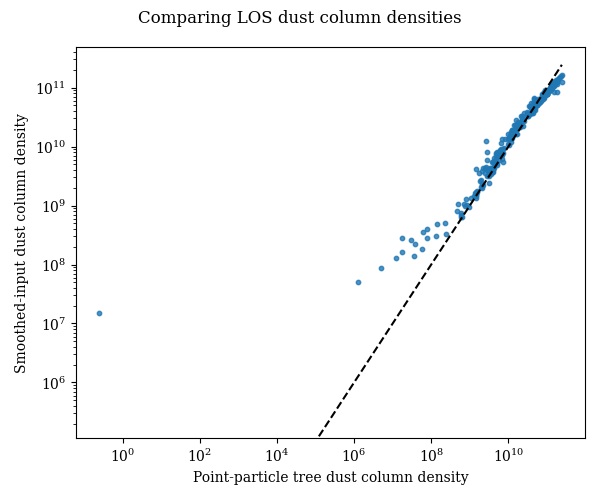
This example compares line-of-sight dust column densities computed by treating the input particles as point sources and by averaging over their smoothing kernels.
This also profiles the point-particle loop path, the point-particle tree path, and the smoothed-input tree path on the same particle distribution.
Pass --refine to resample the CAMELS seed geometry up to a larger particle
set for a more demanding timing comparison.
Point-particle loop LOS column densities took 0.0012 s for nstars=278 and ngas=64
Point-particle tree LOS column densities took 0.0002 s for nstars=278 and ngas=64
Smoothed-input tree LOS column densities took 1.8361 s for nstars=278 and ngas=64
Point tree / loop timing ratio: 0.2007
Smoothed tree / point tree timing ratio: 7866.2666
Point-path residual (tree vs loop): 6.1035e-05 Msun/Mpc**2
Column density sums: point-loop=1.2118e+13 Msun/Mpc**2, point-tree=1.2118e+13 Msun/Mpc**2, smoothed=1.0445e+13 Msun/Mpc**2
import argparse
import time

import matplotlib.pyplot as plt
import numpy as np

from synthesizer import TEST_DATA_DIR
from synthesizer.kernel_functions import Kernel
from synthesizer.load_data.load_camels import load_CAMELS_IllustrisTNG
from synthesizer.particle.galaxy import Galaxy
from synthesizer.particle.gas import Gas
from synthesizer.particle.stars import Stars

plt.rcParams["font.family"] = "DeJavu Serif"
plt.rcParams["font.serif"] = ["Times New Roman"]


# Parse optional arguments. Use parse_known_args so the example remains robust
# when run by external tooling that may add unrelated command-line arguments.
parser = argparse.ArgumentParser()
parser.add_argument(
    "--refine",
    action="store_true",
    help=(
        "Resample the CAMELS seed geometry to 1000 stars and 10000 gas "
        "particles before running the LOS comparison."
    ),
)
args, _ = parser.parse_known_args()

# Set the seed
np.random.seed(42)

# Load the CAMELS test galaxies and select one with both stars and gas. The
# local test snapshot is small, so we optionally resample around it when the
# refine flag is enabled.
camels_galaxies = load_CAMELS_IllustrisTNG(
    TEST_DATA_DIR,
    snap_name="camels_snap.hdf5",
    group_name="camels_subhalo.hdf5",
    group_dir=TEST_DATA_DIR,
)
template_galaxy = camels_galaxies[0]


def resample_coordinates(coordinates, smoothing_lengths, nparticles):
    """Resample a particle distribution around a template geometry."""
    # Draw particles with replacement from the small CAMELS seed system, then
    # jitter them by a fraction of their smoothing length. This preserves the
    # rough spatial scale and LOS geometry of the template while creating a
    # larger benchmark problem for the tree and loop implementations.
    indices = np.random.choice(
        coordinates.shape[0], size=nparticles, replace=True
    )
    base_coords = coordinates[indices].to("Mpc")
    base_smls = smoothing_lengths[indices].to("Mpc")
    jitter = np.random.normal(0.0, 0.25, size=(nparticles, 3))
    return base_coords + base_smls[:, None] * jitter, base_smls


if args.refine:
    # Build a larger synthetic system with the same broad geometry as the local
    # CAMELS example. This keeps the example self-contained while still
    # giving a more demanding comparison between the LOS algorithms.
    nstars = 1000
    ngas = 10000

    star_coords, star_smls = resample_coordinates(
        template_galaxy.stars.coordinates,
        template_galaxy.stars.smoothing_lengths,
        nstars,
    )
    star_indices = np.random.choice(
        template_galaxy.stars.nparticles,
        size=nstars,
        replace=True,
    )
    stars = Stars(
        initial_masses=template_galaxy.stars.initial_masses[star_indices],
        ages=template_galaxy.stars.ages[star_indices],
        metallicities=template_galaxy.stars.metallicities[star_indices],
        redshift=template_galaxy.redshift,
        coordinates=star_coords,
        current_masses=template_galaxy.stars.current_masses[star_indices],
        smoothing_lengths=star_smls,
    )

    gas_coords, gas_smls = resample_coordinates(
        template_galaxy.gas.coordinates,
        template_galaxy.gas.smoothing_lengths,
        ngas,
    )
    gas_indices = np.random.choice(
        template_galaxy.gas.nparticles,
        size=ngas,
        replace=True,
    )
    gas = Gas(
        masses=template_galaxy.gas.masses[gas_indices],
        metallicities=template_galaxy.gas.metallicities[gas_indices],
        star_forming=template_galaxy.gas.star_forming[gas_indices],
        redshift=template_galaxy.redshift,
        coordinates=gas_coords,
        smoothing_lengths=gas_smls,
        dust_to_metal_ratio=template_galaxy.gas.dust_to_metal_ratio,
    )

    galaxy = Galaxy("Refined CAMELS Galaxy", stars=stars, gas=gas, redshift=1)
else:
    galaxy = template_galaxy
    nstars = galaxy.stars.nparticles
    ngas = galaxy.gas.nparticles

# Use a Kernel instance so both the point-particle and smoothed-input paths
# can access the look-up tables they need. In point mode the projected kernel
# is used, while in smoothed mode the same object also provides the overlap
# table needed to average the LOS column density across the input-particle
# support.
kernel = Kernel(name="cubic", binsize=256)

# Calculate LOS dust column densities in three configurations:
#
# 1. point-particle loop: evaluate the point-particle LOS approximation with a
#    direct double loop,
# 2. point-particle tree: evaluate the same point-particle approximation with
#    tree acceleration,
# 3. smoothed-input tree: evaluate the kernel-averaged LOS column density by
#    averaging over the stellar smoothing kernel.
#
# Comparing all three in one place makes it clear how much the tree helps for
# the point-particle approximation and what extra cost is paid for the
# kernel-averaged smoothed-input treatment.
start = time.time()
point_loop_col_den = galaxy.stars.get_los_column_density(
    galaxy.gas,
    "dust_masses",
    kernel=kernel,
    as_points=True,
    force_loop=1,
)
point_loop_time = time.time() - start

start = time.time()
point_tree_col_den = galaxy.stars.get_los_column_density(
    galaxy.gas,
    "dust_masses",
    kernel=kernel,
    as_points=True,
    force_loop=0,
    min_count=32,
)
point_tree_time = time.time() - start

start = time.time()
smoothed_col_den = galaxy.stars.get_los_column_density(
    galaxy.gas,
    "dust_masses",
    kernel=kernel,
    as_points=False,
    force_loop=0,
    min_count=32,
)
smoothed_time = time.time() - start

# Report both the absolute timings and a few simple diagnostics. The point-path
# residual should stay small because the loop and tree are evaluating the same
# point-particle problem, while the smoothed-input sum is expected to differ
# because it is solving a different, kernel-averaged LOS problem.
print(
    f"Point-particle loop LOS column densities took {point_loop_time:.4f} s "
    f"for nstars={nstars} and ngas={ngas}"
)
print(
    f"Point-particle tree LOS column densities took {point_tree_time:.4f} s "
    f"for nstars={nstars} and ngas={ngas}"
)
print(
    f"Smoothed-input tree LOS column densities took {smoothed_time:.4f} s "
    f"for nstars={nstars} and ngas={ngas}"
)
print(
    f"Point tree / loop timing ratio: {point_tree_time / point_loop_time:.4f}"
)
print(
    f"Smoothed tree / point tree timing ratio: "
    f"{smoothed_time / point_tree_time:.4f}"
)
print(
    f"Point-path residual (tree vs loop): "
    f"{np.max(np.abs(point_tree_col_den - point_loop_col_den)):.4e}"
)
print(
    f"Column density sums: point-loop={np.sum(point_loop_col_den):.4e}, "
    f"point-tree={np.sum(point_tree_col_den):.4e}, "
    f"smoothed={np.sum(smoothed_col_den):.4e}"
)


# Plot the point-tree and smoothed-input answers against one another. The
# dashed one-to-one line is only a visual guide: departures from that line are
# expected because the smoothed-input result averages over each stellar kernel
# rather than evaluating the LOS column density only at the stellar centre.
fig, ax = plt.subplots(figsize=(6, 5))

ax.scatter(point_tree_col_den, smoothed_col_den, s=10, alpha=0.8)
ax.plot(
    [np.min(point_tree_col_den), np.max(point_tree_col_den)],
    [np.min(point_tree_col_den), np.max(point_tree_col_den)],
    linestyle="--",
    color="black",
)
ax.set_xscale("log")
ax.set_yscale("log")
ax.set_xlabel("Point-particle tree dust column density")
ax.set_ylabel("Smoothed-input dust column density")

fig.suptitle("Comparing LOS dust column densities")
fig.tight_layout()
plt.show()
Total running time of the script: (0 minutes 1.967 seconds)